Property or Flat Buying Guide 2026: 8 Legal Documents You Must Check Before Purchasing in India

Property or Flat Buying Guide 2026: 8 Legal Documents You Must Check Before Purchasing in India
Registration alone is NOT proof of ownership – Here’s what every smart homebuyer must verify before investing.
Buying a property in India is one of the biggest financial decisions of your life. Whether you are purchasing a 1 BHK apartment, a 2 BHK flat, a luxury residence, or a land parcel, a single legal mistake can cost you lakhs — even crores — and years of legal stress.
Many buyers believe that once the Sale Deed is registered, they become the legal owner. However, multiple judicial observations, including rulings from the Supreme Court of India, have clarified that registration alone does not guarantee clear and marketable title if the underlying ownership chain is defective.
This ultra-detailed SEO-optimized 2026 guide explains the 8 most important property documents you must verify before buying a flat or property in India.
Why Property Document Verification Is Critical in India
India’s real estate ecosystem includes:
- Freehold properties
- Leasehold properties
- Agricultural land
- Converted NA land
- Redevelopment projects
- Under-construction projects
- Resale flats
Due to historical ownership transfers, inheritance disputes, and incomplete records, title defects are common.
Without proper legal due diligence, buyers face:
- Title disputes
- Bank auction risks
- Illegal construction notices
- Demolition orders
- RERA penalties
- Loss of resale value
This is why property document verification in India is not optional — it is essential.
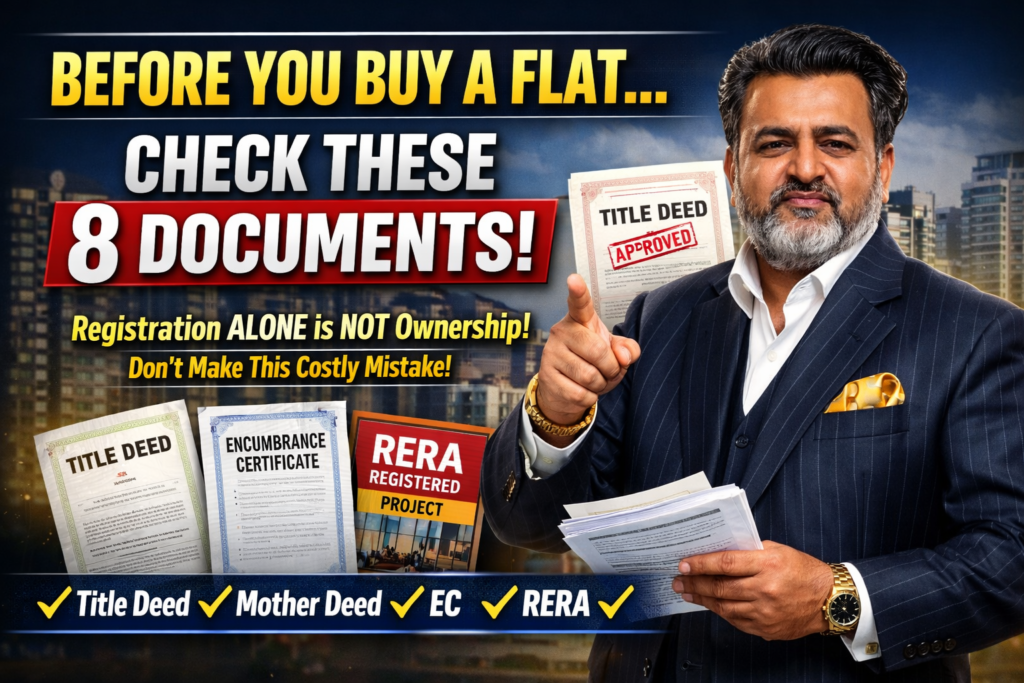
The 8 Mandatory Legal Documents to Check Before Buying Property in India
1. Title Deed – Proof of Legal Ownership
What is a Title Deed?
A Title Deed is the primary legal document that establishes ownership rights of a property.
It must clearly mention:
- Seller’s name
- Property description
- Survey number / CTS number
- Built-up area
- Consideration amount
- Boundaries
What to Verify:
✔ Seller’s name matches government records
✔ No third-party claims
✔ Clear and marketable title
✔ No legal disputes pending
Why It Matters:
If the title is defective, your registration becomes vulnerable. Even banks may refuse loans for disputed titles.
2. Mother Deed – Property Ownership History
What is a Mother Deed?
A Mother Deed traces the ownership chain of the property for 20–30 years.
It shows:
- Previous owners
- How property transferred (sale, gift, inheritance)
- Legal continuity
What to Check:
✔ Complete chain without gaps
✔ Proper execution of each transfer
✔ No missing link documents
Why It’s Important:
If even one transaction in the chain is invalid, the entire ownership may be challenged in court.
3. Encumbrance Certificate (EC) – Loan & Liability Check
What is an Encumbrance Certificate?
An EC shows whether the property has:
- Home loans
- Mortgages
- Legal claims
- Attachments
What to Verify:
✔ Minimum 15–20 years EC
✔ “Nil Encumbrance” entry
✔ No active mortgage
Why It Matters:
If a property is mortgaged and you buy it without verifying EC, the bank can legally auction it.
4. Approved Building Plan
For apartments and flats, ensure:
✔ Approved plan from local municipal authority
✔ FSI compliance
✔ No illegal extensions
Risks of Ignoring This:
- Demolition notices
- Penalties
- Refusal of Occupancy Certificate
- Lower resale value
Unauthorized construction is one of the biggest legal risks in Indian real estate.
5. Occupancy Certificate (OC)
What is an OC?
Issued by municipal authorities confirming:
- Building complies with sanctioned plan
- Safe for occupancy
- Civic norms met
Why You Must Check:
Without OC:
- No proper water connection
- No electricity meter
- Difficulty in resale
- Legal complications
Banks often reject loans for properties without OC.
6. Completion Certificate (CC)
Completion Certificate confirms that:
- Construction completed as per approved plan
- No deviations beyond permissible limits
It is crucial in under-construction projects.
7. Property Tax Receipts
Verify: ✔ Last 3–5 years tax receipts
✔ No pending dues
✔ Name matches seller
If property tax is unpaid, the liability may shift to the new owner.
8. Possession Certificate
Confirms physical possession of the property.
Ensure: ✔ Seller actually occupies property
✔ No tenants without agreement
✔ No possession disputes
Legal possession is as important as legal title.
Is Registration Enough?
No.
Registration confirms that a document was recorded in government records. It does NOT guarantee:
- Clear title
- Absence of dispute
- Freedom from encumbrance
- Legality of construction
Registration validates execution — not ownership authenticity.
RERA Registration – Mandatory for Under-Construction Projects
Under the Real Estate (Regulation and Development) Act, 2016, all eligible projects must be registered with RERA.
Before buying:
✔ Check project registration number
✔ Verify delivery timeline
✔ Check complaints history
✔ Review builder track record
RERA protects homebuyers from delays and fraud.
Bank Approval – Additional Layer of Safety
If a reputed nationalized bank approves a project, it usually means:
- Legal scrutiny done
- Technical valuation completed
- Builder credibility verified
However, do not depend solely on bank approval.
Land Conversion & NA Status
If purchasing land or plotted development:
✔ Ensure agricultural land converted to NA (Non-Agricultural)
✔ Check land use zoning
✔ Confirm local authority permissions
Buying agricultural land illegally can result in cancellation.
Khata / Patta / 7/12 Extract
Depending on state:
- Maharashtra → 7/12 Extract
- Karnataka → Khata Certificate
- Tamil Nadu → Patta
- Gujarat → Property Card
These documents confirm revenue records.
Legal Due Diligence Checklist for 2026
Before signing any agreement:
- Hire property lawyer
- Conduct title search
- Verify EC
- Check RERA registration
- Validate municipal approvals
- Inspect property physically
- Confirm no litigation
- Check society NOC
Common Mistakes Homebuyers Make
❌ Trusting only the builder
❌ Signing documents without reading
❌ Ignoring legal opinion
❌ Buying without EC
❌ Not checking OC
❌ Paying cash without agreement
How to Conduct Property Title Search in India
A professional property lawyer will:
- Visit Sub-Registrar office
- Verify past 30 years records
- Check court litigation records
- Validate mutation entries
- Confirm property tax compliance
This small legal fee can save lifetime losses.
Real Estate Investment Safety Tips
- Never rush due to “limited offer” pressure
- Avoid projects without RERA
- Verify builder’s previous delivery record
- Check Google reviews and litigation history
- Avoid undervalued suspicious deals
Why Legal Awareness Is Increasing in 2026
With rising property prices:
- Buyers are more cautious
- Banks stricter in approvals
- RERA enforcement stronger
- Online land records more accessible
Digital transparency is improving — but fraud still exists.
Final Conclusion
Buying property is emotional.
But verification must be logical.
Always remember:
A beautiful flat without clear documents is a financial trap.
Before you invest:
- Verify title
- Check EC
- Confirm approvals
- Ensure RERA registration
- Consult lawyer
Smart buyers verify first, invest later.
FAQs – Property Document Verification India
Q1. Is Sale Deed enough for ownership?
No. Clear title chain and EC are equally important.
Q2. Can I buy property without OC?
Technically possible, but risky and banks may refuse loans.
Q3. How many years EC should I check?
Minimum 15 years, ideally 20–30 years.
Q4. Is RERA mandatory?
Yes for eligible new projects.
Q5. Should I hire a property lawyer?
Absolutely yes.
Discover more from Dream Property 99
Subscribe to get the latest posts sent to your email.